
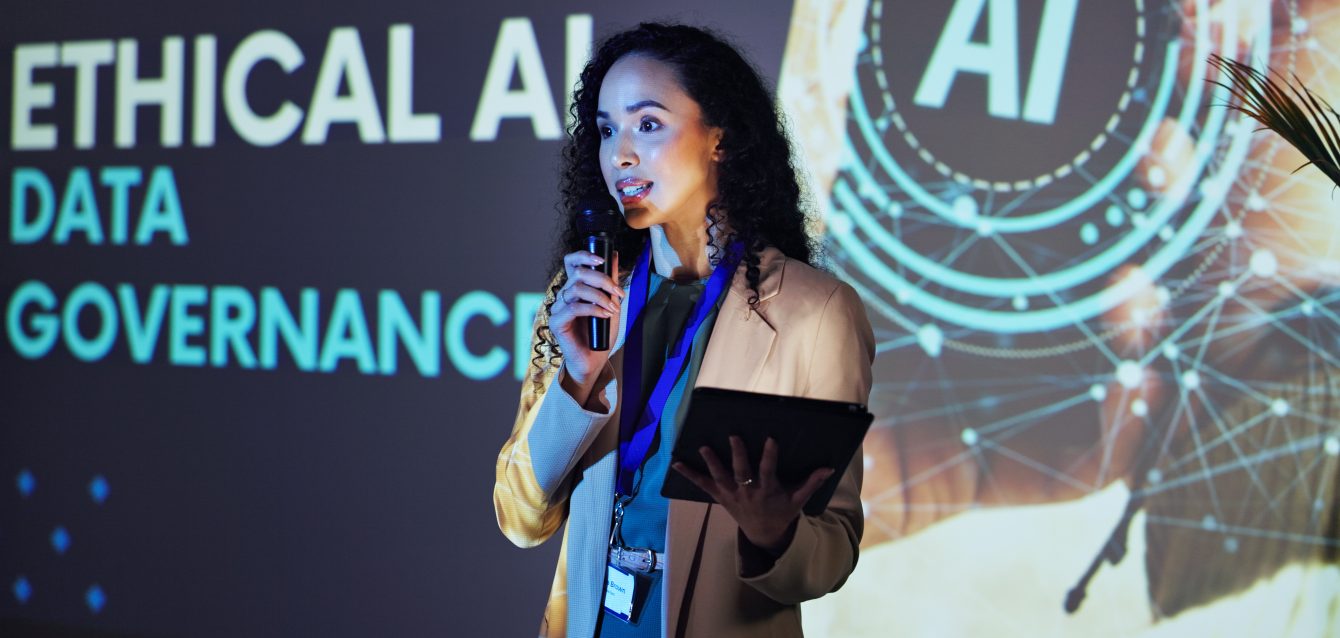
Introduction: The New Mandate for Digital Leadership
The rapid acceleration of Artificial Intelligence (AI) is fundamentally reshaping the global business landscape. From optimizing supply chains and personalizing customer experiences to driving complex decision-making, AI has become the engine of modern digital transformation. For business leaders in the UAE and across the globe, the question is no longer if to adopt AI, but how to adopt it responsibly and sustainably.
The immense power of AI comes with an equally immense responsibility. Unchecked, AI systems can perpetuate and amplify societal biases, erode customer trust through opaque decision-making, and create significant legal and reputational risks. Therefore, the next frontier of digital leadership is not just technological capability, but Ethical AI—a commitment to designing, developing, and deploying systems that prioritize Fairness, Transparency, and Accountability. This commitment is not merely a moral obligation; it is a strategic imperative that directly impacts a company’s bottom line, market reputation, and long-term viability.
Quantum1st Labs a leading technology firm specializing in AI development, blockchain solutions, cybersecurity, and IT infrastructure, understands this mandate implicitly. Based in Dubai, UAE, and part of the SKP Business Federation, Quantum1st is dedicated to guiding organizations through this complex landscape, ensuring that their digital transformation is built on a foundation of trust and ethical rigor. This article explores the three core pillars of Ethical AI and outlines the practical steps business leaders must take to secure their future in the AI-driven economy.
The Strategic Imperative of Ethical AI
For too long, ethical considerations were viewed as a regulatory hurdle or a cost center. Today, they are recognized as a powerful value driver and a source of competitive advantage. Business leaders who proactively embrace responsible AI frameworks are positioning their organizations for sustainable growth and market leadership.
Beyond Compliance: The Business Case for Responsible AI
The business case for Ethical AI extends far beyond avoiding fines and litigation. It is rooted in enhancing core business functions and securing stakeholder trust:
- Risk Mitigation and Resilience: AI systems that are biased or opaque are inherently fragile. They expose the organization to legal challenges (e.g., discrimination lawsuits), regulatory penalties (e.g., GDPR, local data protection laws), and catastrophic reputational damage. A robust ethical framework acts as a critical layer of operational resilience.
- Enhanced Customer Trust and Loyalty: In an era of increasing data scrutiny, consumers are more likely to engage with brands they trust. When a company can clearly explain how an AI system arrived at a decision—whether it’s a loan approval, a medical diagnosis, or a legal recommendation—it builds profound confidence. This transparency translates directly into higher customer loyalty and lifetime value.
- Competitive Differentiation: As AI becomes ubiquitous, ethical practice becomes a key differentiator. Companies that can credibly market their AI as “fair by design” and “transparent by default” gain a significant edge, attracting top talent, ethical investors, and discerning clients.
The UAE Context: Digital Transformation and Ethical Leadership
The UAE, particularly Dubai, has established itself as a global hub for innovation and digital transformation. This rapid technological adoption necessitates a proactive approach to AI governance. The region’s vision for a future-ready economy requires not just cutting-edge technology, but also the ethical frameworks to ensure that this technology serves all members of society fairly. Companies like Quantum1st Labs are at the forefront, helping to establish the standards for AI Governance and ethical deployment that align with the UAE’s forward-thinking regulatory environment.
Pillar 1: Ensuring Fairness and Mitigating Algorithmic Bias
Fairness is the cornerstone of Ethical AI. An AI system is only as good as the data it is trained on, and if that data reflects historical or systemic biases, the AI will not only replicate those biases but often amplify them at scale. This can lead to discriminatory outcomes in hiring, lending, criminal justice, and other critical areas.
Understanding Algorithmic Bias
Algorithmic bias can creep into AI systems at multiple stages:
- Data Bias: The most common source. If a historical dataset used to train a hiring AI predominantly features male candidates, the model may learn to unfairly penalize female applicants, regardless of their qualifications.
- Design Bias: Bias introduced by the developers’ assumptions, the choice of features, or the selection of an inappropriate performance metric. For example, optimizing a system solely for “accuracy” might mask poor performance for minority groups.
- Deployment Bias: Bias that emerges when a model is deployed in a real-world context that differs significantly from its training environment.
Strategies for Achieving Fairness
Mitigating bias requires a multi-faceted approach that spans the entire AI lifecycle:
- Data Auditing and Debiasing: This involves rigorous inspection of training data for demographic imbalances and proxies for protected attributes. Techniques such as re-weighting, sampling, and adversarial debiasing are used to neutralize harmful correlations before the model is trained.
- Defining and Measuring Fairness: Fairness is not a single concept. Organizations must define which fairness metric is most appropriate for their specific use case (e.g., demographic parity, equal opportunity, or equalized odds). This requires deep domain expertise and collaboration with stakeholders.
- Continuous Monitoring: Bias is not static. Models can drift over time as real-world data changes. Continuous monitoring and re-calibration are essential to ensure the model remains fair throughout its operational life.
Quantum1st Labs’ work in high-stakes environments, such as the legal sector (e.g., the Nour Attorneys Law Firm project involving 1.5+ TB of legal data), highlights the critical need for fairness. In legal and regulatory contexts, a biased AI recommendation is unacceptable. Quantum1st’s approach integrates rigorous data validation and fairness checks into the core of its AI development, ensuring the 95% accuracy is achieved without compromising ethical standards.
Pillar 2: Demanding Transparency and Explainability
The “black box” nature of many advanced AI models, particularly deep neural networks, presents a significant challenge to trust and accountability. When an AI makes a critical decision—such as denying a loan or flagging a transaction for fraud—stakeholders demand to know why. AI Transparency and Explainable AI (XAI) are the solutions to this challenge.
The Black Box Problem
Opaque AI systems create several problems for business leaders:
- Lack of Auditability: Without a clear understanding of the decision-making process, it is impossible to audit the system for errors, bias, or regulatory compliance.
- Difficulty in Debugging: When a system fails or produces an unexpected result, developers cannot easily trace the error back to its source, leading to prolonged downtime and unresolved issues.
- Erosion of User Trust: Users and regulators are unlikely to trust a system whose logic is hidden. This is particularly true in sensitive sectors like finance, healthcare, and law.
Explainable AI (XAI) as a Solution
XAI refers to a set of techniques that allow humans to understand the output of AI models. This moves the system from a simple predictor to a collaborative tool:
- Local vs. Global Explanations: Local explanations (e.g., LIME, SHAP) detail why a specific, single prediction was made. Global explanations provide a broader view of how the model works overall.
- Model Documentation and Fact Sheets: Comprehensive documentation detailing the model’s purpose, training data, performance metrics, limitations, and intended use is crucial for internal transparency and governance.
- Simpler, Inherently Interpretable Models: For certain high-stakes applications, simpler models (like decision trees or linear models) may be preferred over complex neural networks, sacrificing a marginal degree of accuracy for complete interpretability.
Quantum1st Labs integrates XAI techniques into its development lifecycle, ensuring that even complex AI solutions, such as the customizable ERP and Business AI systems developed for SKP Federation, are deployed with clear, human-readable explanations. This commitment to transparency allows business leaders to confidently integrate AI into their core operations, knowing they can justify every automated decision.
Pillar 3: Establishing Accountability and Governance
Accountability is the final, non-negotiable pillar of Ethical AI. It ensures that there is a clear line of responsibility for the outcomes of an AI system, regardless of its autonomy. Without clear accountability, ethical principles remain theoretical, and the risks associated with AI deployment become unmanageable.
Defining the Accountability Chain
The challenge of accountability in AI is defining who is responsible when an autonomous system makes an error. The answer must be a human or a human-led entity.
- The Role of Human Oversight: AI systems must be designed with human-in-the-loop mechanisms, particularly for high-risk decisions. Humans must retain the ultimate authority to override, pause, or decommission an AI system.
- Establishing AI Ethics Boards: Many leading organizations are establishing dedicated AI Ethics Boards or committees. These cross-functional groups—comprising legal, technical, and ethical experts—are responsible for setting policy, reviewing high-risk projects, and ensuring adherence to the organization’s ethical framework.
- Regulatory Frameworks: Business leaders must stay ahead of evolving regulations. In the absence of a single global standard, organizations must adopt the highest applicable standard, often drawing from principles established by the EU, the OECD, and local government initiatives.
Implementing Robust AI Governance
Effective AI Governance requires more than just a policy document; it demands a technical and organizational infrastructure to support it.
- Secure and Auditable IT Infrastructure: Ethical AI requires a foundation of secure, well-managed data and infrastructure. Quantum1st Labs’ expertise in Cybersecurity and IT Infrastructure is vital here, providing the secure data pipelines, access controls, and auditable logging mechanisms necessary to track AI decisions and ensure compliance.
- Blockchain for Audit Trails: Quantum1st’s specialization in Blockchain Solutions offers a powerful tool for accountability. Immutable ledgers can be used to record every input, parameter change, and output of an AI model, creating a tamper-proof audit trail that satisfies the most stringent regulatory requirements for transparency and accountability.
- Continuous Auditing and Monitoring: Governance is an ongoing process. Regular, independent audits of AI systems—checking for bias, performance drift, and compliance—are essential to maintain ethical integrity.
Quantum1st Labs: A Framework for Ethical Digital Transformation
Quantum1st Labs is uniquely positioned to partner with business leaders in the MENA region to build and deploy Ethical AI solutions. Their comprehensive approach integrates ethical considerations across their core service offerings, ensuring a holistic and secure digital transformation.
Integrating Ethics Across Core Services
Quantum1st’s commitment to Ethical AI is evident in the integration of ethical principles into every service line:
| Quantum1st Service | Ethical AI Integration | Business Value |
|---|---|---|
| AI Development | Fairness by Design: Rigorous data auditing, bias mitigation, and the use of XAI techniques to ensure models are interpretable and equitable. | Reduces legal risk, enhances model accuracy, and ensures responsible innovation. |
| Cybersecurity & IT Infrastructure | Accountability Foundation: Providing secure, auditable, and resilient infrastructure with robust access controls and immutable logging for AI decision-making. | Guarantees compliance, protects sensitive data, and establishes a clear accountability chain. |
| Blockchain Solutions | Transparency & Auditability: Utilizing immutable ledgers to record AI model parameters, training data versions, and decision outputs, creating a tamper-proof audit trail. | Provides irrefutable evidence for regulatory compliance and builds external trust. |
| Digital Transformation Consulting | Governance Roadmap: Advising business leaders on establishing AI Ethics Boards, developing internal policies, and creating a culture of responsible innovation. | Transforms ethical concerns into a strategic competitive advantage. |
Case Study Insight: High-Stakes Accuracy and Ethics
The development of the AI system for Nour Attorneys Law Firm serves as a prime example of Quantum1st’s ethical approach. Processing over 1.5+ TB of complex legal data, the system was required to achieve a 95% accuracy rate. However, accuracy alone was insufficient. The system had to be meticulously designed to ensure:
- Fairness: The AI’s recommendations could not be based on discriminatory factors present in historical case data.
- Transparency: Legal professionals needed clear, traceable explanations for every recommendation to maintain professional accountability.
- Accountability: The system was integrated with clear human-in-the-loop processes, ensuring the final legal advice remained the responsibility of the attorney, supported by an ethically sound AI.
This project demonstrates that high performance and high ethical standards are not mutually exclusive; they are symbiotic.
Conclusion: Securing the Future with Responsible AI
The era of deploying AI without a corresponding ethical framework is rapidly drawing to a close. For business leaders, particularly those driving the digital future of the MENA region, Ethical AI is no longer an optional add-on but a fundamental requirement for sustainable success.
By focusing on the three pillars of Fairness, Transparency, and Accountability, organizations can transform potential risks into powerful opportunities. They can build deeper trust with customers, attract and retain the best talent, and secure a resilient competitive position in the global market. The commitment to Ethical AI is the commitment to a future where technology serves humanity equitably and responsibly.
The journey to ethical digital transformation is complex, requiring specialized expertise in AI governance, secure infrastructure, and cutting-edge technologies like blockchain. Quantum1st Labs stands ready to be your strategic partner in this endeavor, providing the technical solutions and ethical frameworks necessary to ensure your AI strategy is both powerful and principled.
Key Takeaways for Business Leaders
- Ethical AI is a Value Driver: It enhances customer loyalty, mitigates legal and reputational risk, and provides a competitive edge.
- Fairness Requires Data Auditing: Proactively identify and neutralize algorithmic bias in training data and model design.
- Transparency Demands XAI: Implement Explainable AI (XAI) techniques to ensure all high-stakes decisions are auditable and justifiable.
- Accountability Needs Governance: Establish clear human oversight, AI Ethics Boards, and secure, auditable IT infrastructure (like that provided by Quantum1st Labs) to track and manage AI outcomes.