The global business landscape is undergoing a profound transformation, driven by the rapid advancement of Artificial Intelligence (AI). At the core of this revolution, enabling everything from sophisticated financial modeling to hyper-accurate legal analysis, lies a technology known as the Neural Network. For business leaders, understanding the complex mathematics and code behind this technology is unnecessary; what is critical is grasping its fundamental function, its immense potential, and its strategic value in driving digital transformation.
This article serves as a non-technical guide to demystifying neural networks. We will explore the core concepts that allow these systems to “learn,” examine their practical applications across various industries, and illustrate how a strategic partner like Quantum1st Labs leverages this technology to deliver tangible, high-impact business solutions. The goal is to equip executives with the conceptual framework needed to integrate AI effectively into their corporate strategy, ensuring they remain competitive in the data-driven economy.
The Brain of Modern AI: What is a Neural Network?
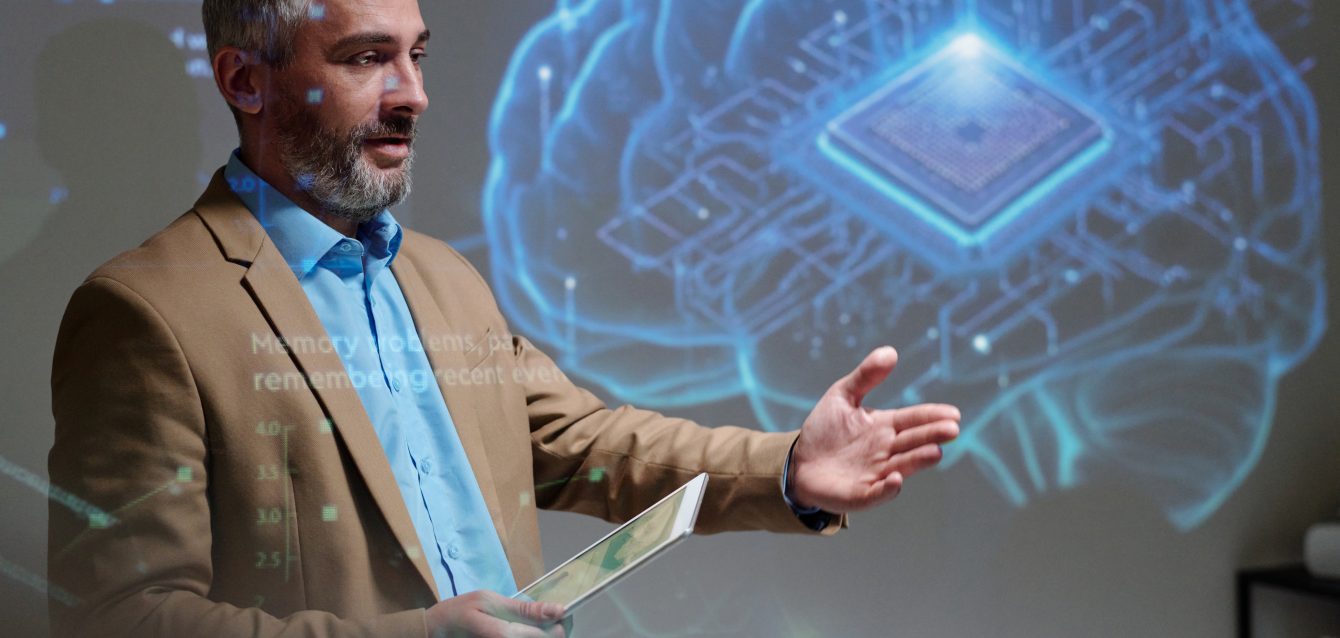
A neural network, or Artificial Neural Network (ANN), is a computational model inspired by the structure and function of the human brain. It is not a single piece of software but a framework designed to recognize patterns and make predictions based on vast amounts of data. Unlike traditional programming, where a developer explicitly writes rules for every possible scenario, a neural network learns the rules itself.
A Simple Analogy: The Human Decision-Making Process
Imagine a child learning to identify a cat. No one gives the child a list of rules like “if it has pointy ears AND whiskers AND meows, it is a cat.” Instead, the child is shown hundreds of examples—pictures of cats, dogs, and other animals—and is told, “This is a cat.” Over time, the child’s brain adjusts its internal connections to recognize the patterns that define “cat.”
A neural network operates on the same principle. It is fed data (the “examples”) and adjusts its internal structure (the “connections”) until it can reliably identify the correct output (the “cat”) from new, unseen input. This ability to learn from experience is what makes neural networks the engine of modern AI.
The Core Components: Nodes, Layers, and Connections
A neural network is organized into three fundamental types of layers:
- The Input Layer: This is where the data enters the network. If the network is analyzing a photograph, the input layer receives the data for each pixel. If it is analyzing a financial report, the input layer receives data points like revenue, stock price, and market volatility.
- The Hidden Layers: These are the computational engine of the network. Each layer is composed of nodes (or “neurons”) that receive input from the previous layer, perform a simple calculation, and pass the result to the next layer. The “deep” in deep learning simply refers to a network that has multiple hidden layers, allowing it to process increasingly complex and abstract patterns.
- The Output Layer: This layer delivers the final result. For example, in a classification task, the output might be a probability score indicating the likelihood that the input data belongs to a specific category (e.g., 95% chance this email is spam).
The power of the network lies in the connections between these nodes. Each connection has a weight, which is essentially a measure of its importance. When the network is learning, it is constantly adjusting these weights to improve the accuracy of its predictions.
The Learning Process: How Neural Networks Get Smart
The process by which a neural network transitions from a blank slate to a powerful predictive tool is a sophisticated form of trial and error, managed through a continuous feedback loop.
Training: The Power of Labeled Data
The vast majority of neural networks are trained using supervised learning. This requires a large dataset where the input is paired with the correct, known output—the “label.”
- Input: A picture of a cancerous cell.
- Label: “Malignant.”
The network processes the input and makes a guess. Initially, the guess is random. The network then compares its guess to the correct label. The difference between the guess and the label is the error.
The Feedback Loop: Error Correction and Optimization
The error is the crucial signal that drives learning. The network uses a technique called backpropagation to adjust its internal weights. In non-technical terms, backpropagation is the process of sending the error signal backward through the network, layer by layer.
Imagine a complex machine with thousands of dials (the weights). When the machine produces a faulty product (the error), backpropagation determines which dials contributed most to the fault and by how much they need to be turned to correct the output. This process is repeated thousands or millions of times with different data points until the network’s error rate is minimized. This iterative refinement is what allows the network to generalize its knowledge and make accurate predictions on data it has never seen before.
Deep Learning: The Significance of Multiple Layers
The term deep learning is often used interchangeably with neural networks, but it specifically refers to networks with a greater depth of hidden layers. This depth allows the network to break down complex problems into a hierarchy of simpler concepts.
For instance, in image recognition:
- Layer 1 might learn to recognize simple edges and lines.
- Layer 2 combines edges to recognize shapes (circles, squares).
- Layer 3 combines shapes to recognize features (eyes, noses, wheels).
- Layer 4 combines features to recognize the final object (a face, a car).
This hierarchical feature extraction is why deep learning models excel at tasks involving unstructured data like images, video, and natural language, which are often too complex for traditional machine learning models.
Beyond the Hype: Practical Business Applications of Neural Networks
The true value of neural networks is not in their technical complexity but in their ability to solve critical business challenges and unlock new revenue streams. For business leaders, the focus should be on the capability these networks provide.
Predictive Analytics and Forecasting
Neural networks are unparalleled in their ability to detect subtle, non-linear relationships in data, making them superior tools for forecasting and risk management.
| Business Function | Neural Network Application | Business Value |
|---|---|---|
| Finance | High-frequency trading, credit risk scoring, fraud detection. | Reduced financial loss, optimized investment strategies, regulatory compliance. |
| Supply Chain | Demand forecasting, predictive maintenance, logistics optimization. | Minimized inventory costs, reduced downtime, improved operational efficiency. |
| Healthcare | Medical image–based disease diagnosis (X-rays, MRIs), drug discovery. | Faster, more accurate diagnoses, accelerated R&D cycles. |
Enhanced Customer Experience and Personalization
Neural networks power the most sophisticated customer-facing AI systems, leading to higher engagement and loyalty.
- Natural Language Processing (NLP): Networks like those used in large language models (LLMs) can understand, interpret, and generate human language. This is vital for advanced chatbots, automated customer service, and sentiment analysis of customer feedback.
- Recommendation Engines: By analyzing vast amounts of user behavior data, NNs can predict what a customer is likely to buy, watch, or click next, driving sales and improving the user journey.
- Personalized Marketing: NNs segment customers with extreme precision, allowing for marketing campaigns that are tailored to individual preferences, maximizing conversion rates.
Automation and Efficiency
In operational settings, neural networks drive efficiency by automating complex, repetitive tasks that require human-like perception or decision-making.
- Quality Control: In manufacturing, computer vision networks can inspect products on an assembly line with superhuman speed and consistency, identifying defects that a human eye might miss.
- Data Processing: Networks can automatically extract relevant information from unstructured documents (invoices, contracts, legal filings), drastically reducing manual data entry and processing time.
The Quantum1st Labs Advantage: Neural Networks in Action
As a leading technology firm in the UAE, Quantum1st Labs,part of the SKP Business Federation, specializes in harnessing the power of neural networks to drive measurable business outcomes for its clients across the Middle East and globally. Our expertise spans the full spectrum of modern enterprise technology: AI development, blockchain solutions, cybersecurity, and IT infrastructure.
Our approach is not merely about deploying technology; it is about strategic integration. We focus on building bespoke neural network models that are trained on client-specific data to solve unique, high-value problems.
Case Study: High-Accuracy AI in Legal Data Analysis
A prime example of our capability is the work done for Nour Attorneys Law Firm. The legal sector is characterized by massive volumes of complex, unstructured data—contracts, case files, precedents, and regulations. Manually sifting through this data is time-consuming and prone to human error.
Quantum1st Labs developed a specialized AI solution, powered by advanced neural networks, to process and analyze over 1.5+ terabytes of legal data. The network was trained to identify relevant precedents, predict case outcomes, and extract critical clauses from documents. The result was an unprecedented 95% accuracy in legal data analysis and prediction. This level of precision, driven by a deep learning model, transforms the firm’s operational efficiency and strategic decision-making, moving them from reactive to predictive legal practice.
Strategic AI for the Enterprise
Beyond specialized projects, Quantum1st Labs integrates neural networks into core enterprise functions:
- Business AI: We build customizable AI solutions, including the Customizable ERP systems used within the SKP Federation, where neural networks optimize resource allocation, predict maintenance needs, and automate complex reporting.
- Customer Support AI: Our advanced Customer Support AI utilizes sophisticated NLP-based neural networks to handle a high volume of customer interactions, providing personalized, context-aware responses and freeing human agents to focus on complex, high-touch issues.
- Cybersecurity: Neural networks are essential for next-generation cybersecurity. They are trained to recognize the subtle, evolving patterns of cyber threats, identifying zero-day attacks and anomalous network behavior far faster than signature-based systems.
Our commitment is to provide robust, scalable IT infrastructure that supports these demanding AI models, ensuring seamless integration and performance within the client’s existing ecosystem.
Strategic Considerations for Business Leaders
Adopting neural network technology is a strategic investment, not just an IT upgrade. Leaders must consider the foundational elements required to maximize the return on this investment.
Data is the New Oil: The Importance of Clean, Abundant Data
The performance of any neural network is directly proportional to the quality and quantity of the data it is trained on. A network trained on poor or biased data will produce poor or biased results—a concept known as “garbage in, garbage out.”
Business leaders must prioritize:
- Data Governance: Establishing clear policies for data collection, storage, and access.
- Data Cleansing: Investing in processes to ensure data is accurate, complete, and consistently formatted.
- Data Strategy: Identifying and securing the unique, proprietary datasets that will give their AI models a competitive edge.
Ethical AI and Trustworthiness
As neural networks become more influential in high-stakes decisions (e.g., loan approvals, medical diagnoses), the need for ethical AI is paramount. Business leaders must ensure their AI systems are:
- Transparent: Understanding *why* a network made a specific decision (interpretability).
- Fair: Ensuring the network’s predictions are not based on discriminatory biases present in the training data.
- Accountable: Establishing clear human oversight and responsibility for the network’s actions.
Quantum1st Labs incorporates ethical AI principles from the design phase, ensuring that our solutions are not only powerful but also responsible and trustworthy, a critical factor for long-term business sustainability and regulatory compliance in the UAE and beyond.
Integrating AI into Digital Transformation Strategy
Neural networks are not a standalone solution; they are an integral component of a broader digital transformation strategy. Successful integration requires a holistic view that includes:
- Talent Development: Training existing staff to work alongside AI systems and hiring specialized AI talent.
- Process Re-engineering: Redesigning business processes to take full advantage of AI-driven automation and insights.
- Scalability: Ensuring the underlying IT infrastructure, which Quantum1st Labs specializes in, can handle the massive computational demands of deep learning models.
Conclusion: Partnering for an AI-Driven Future
Neural networks represent a fundamental shift in how businesses can process information, predict the future, and interact with their customers. They are the core technology that transforms raw data into actionable intelligence, offering a decisive competitive advantage to those who deploy them strategically.
For business leaders, the path forward is clear: embrace the power of AI, understand its non-technical mechanics, and focus on the strategic outcomes it enables. The success of projects like the high-accuracy legal analysis for Nour Attorneys Law Firm demonstrates the transformative potential when advanced neural networks are paired with deep industry expertise.
The future of business is intelligent, and the foundation of that intelligence is the neural network. To navigate this complex landscape and ensure your organization is positioned for leadership in the AI era, a trusted partner is essential.