
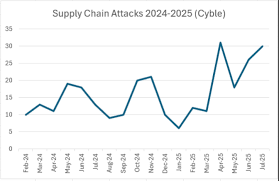
The modern enterprise is no longer a fortress with clearly defined walls. Instead, it is a vast, interconnected ecosystem, reliant on a complex web of third-party vendors, software components, and outsourced services. While this interconnectedness drives efficiency and innovation, it has simultaneously created the most significant cybersecurity vulnerability of the decade: the supply chain attack. For business leaders, this is no longer a theoretical risk; it is the new battleground where the integrity and continuity of their operations are constantly challenged.
The shift in cyber warfare strategy is clear. As large organizations invest heavily in hardening their direct defenses—firewalls, endpoint protection, and in-house security teams—attackers have pivoted to target the weakest link: the less-secure, often smaller, third-party partners who have privileged access to the primary target’s systems. A supply chain attack is a sophisticated form of cyber espionage or sabotage where a threat actor compromises a trusted supplier’s software, hardware, or services to infiltrate the ultimate target. This method offers high leverage, allowing a single breach to cascade across hundreds or even thousands of downstream customers. The growing frequency and sophistication of these attacks demand a proactive, multi-layered defense strategy that treats every external connection as a potential point of failure.
This article provides a comprehensive overview of the escalating threat of supply chain attacks, analyzes their anatomy and impact, and outlines the strategic, technological, and governance measures required to build genuine cyber resilience. For organizations navigating the complexities of digital transformation, securing the supply chain is not merely a technical task—it is a fundamental business imperative.
The Anatomy of a Modern Supply Chain Attack
Supply chain attacks are characterized by their stealth and scale. They exploit the inherent trust between an organization and its vendors, transforming a legitimate business relationship into a conduit for malicious activity. Understanding the mechanics of these attacks is the first step toward effective mitigation.
The Allure of the Weakest Link
Attackers are driven by the principle of maximum return on investment. Compromising a major corporation directly is resource-intensive and often thwarted by advanced security measures. By contrast, a third-party vendor—perhaps a managed service provider (MSP), a software development firm, or a specialized component manufacturer—often has less mature security protocols but possesses the necessary credentials or access to penetrate the main target.
The primary goal is to inject malicious code or backdoors into a product or service that the target organization consumes. When the target installs a seemingly legitimate software update or integrates a new component, they unknowingly introduce the threat into their own environment. This technique bypasses traditional perimeter defenses entirely, as the malicious payload arrives from a trusted source.
Common Attack Vectors
The vectors for supply chain compromise are diverse, reflecting the complexity of modern IT infrastructure.
1. Compromised Software Updates and Distribution
This is arguably the most devastating vector. Attackers infiltrate a software vendor’s build or distribution system and replace a legitimate update with a trojanized version. When customers download and install the update, the malware is executed with the high privileges typically afforded to system software. The SolarWinds attack serves as the definitive example of this vector, demonstrating how a single compromise can affect thousands of government agencies and major corporations globally.
2. Malicious Code Injection in Open-Source Libraries
Modern software development relies heavily on open-source components. Attackers frequently target these public repositories by submitting malicious code disguised as legitimate contributions or by taking over the accounts of maintainers. When developers incorporate these compromised libraries into their applications, the vulnerability is baked directly into the final product, creating a massive, latent risk across the entire software ecosystem. The Log4Shell vulnerability highlighted the pervasive risk associated with widely used, foundational open-source components.
3. Hardware and Firmware Tampering
While less common, attacks on the hardware supply chain are extremely difficult to detect. This involves tampering with physical components during manufacturing or transit, such as implanting malicious chips or altering firmware. Such compromises can grant persistent, low-level access to systems, often below the operating system level, making them invisible to standard security tools.
4. Vendor Credential Theft and Access Exploitation
In many cases, the attack is not on the vendor’s product, but on their access. If a third-party IT support firm has standing administrative credentials to a client’s network, the theft of those credentials becomes a direct path to the client. This vector underscores the critical need for strict third-party access controls and the principle of least privilege.
High-Profile Case Studies: The Scale of the Impact
Examining recent, high-profile incidents reveals the catastrophic potential of supply chain attacks and underscores why they represent an existential threat to business continuity.
| Attack Name | Primary Vector | Target / Victim Profile | Impact Summary |
|---|---|---|---|
| SolarWinds (2020) | Compromised software update via the Orion platform | U.S. government agencies and Fortune 500 companies | Large-scale espionage campaign involving data theft and long-term persistence within highly sensitive networks, exposing the risks of implicit trust in supply chains. |
| Kaseya VSA (2021) | Exploitation of a zero-day vulnerability in VSA software | Managed Service Providers (MSPs) and their downstream clients | Ransomware attack that encrypted systems across more than 1,500 organizations worldwide, leading to severe operational disruption. |
| Log4Shell (2021) | Critical vulnerability in the widely used Log4j open-source library | Internet-facing applications leveraging Java-based components | Global zero-day exploit enabling remote code execution, triggering an urgent worldwide patching effort and underscoring systemic open-source dependency risks. |
These incidents demonstrate that the impact of a supply chain breach extends far beyond immediate financial loss. They result in severe reputational damage, regulatory fines, costly litigation, and the loss of intellectual property protection. For a modern enterprise, the cost of recovery and remediation can dwarf the initial cost of prevention.
The Business Imperative: From Technical Risk to Strategic Governance
For C-suite executives and board members, supply chain risk must be elevated from a technical IT problem to a core strategic governance risk and compliance (GRC) issue. Effective management requires a shift in mindset, focusing on continuous oversight and risk quantification.
Quantifying Cyber Risk
Organizations must move beyond simple qualitative assessments (e.g., “high,” “medium,” “low”) and adopt methodologies for cyber risk quantification. This involves translating potential cyber incidents into financial terms, allowing leaders to make data-driven decisions about security investments. By understanding the potential loss exposure from a compromised vendor, a company can justify the necessary expenditure on advanced security controls and contractual protections.
The Need for Proactive Vendor Risk Management
Traditional vendor risk management often relies on annual questionnaires and audits, which provide only a static snapshot of a dynamic security posture. A proactive approach requires continuous monitoring and a deep understanding of the security controls implemented by every third-party partner with access to critical systems or data.
Key components of proactive vendor risk management include:
- Contractual Mandates: Enforcing strict security requirements, including mandatory penetration testing, incident reporting timelines, and right-to-audit clauses.
- Continuous Monitoring: Utilizing automated tools to monitor vendor security ratings, dark web activity related to the vendor, and changes in their security posture in real-time.
- Access Minimization: Ensuring that third parties only have the minimum level of access required to perform their function (the principle of least privilege) and that this access is automatically revoked when no longer needed.
A Multi-Layered Defense Strategy: Leveraging AI and Blockchain
Securing the digital supply chain requires a defense-in-depth strategy that integrates cutting-edge technologies like Artificial Intelligence and Blockchain—areas where Quantum1st Labs specializes in providing robust, future-proof solutions.
1. Zero Trust Architecture: Trust Nothing, Verify Everything
The foundational principle for mitigating supply chain risk is the adoption of a Zero Trust security model. This model operates on the assumption that no user, device, or network—internal or external—should be trusted by default. Every access request must be authenticated, authorized, and continuously validated.
For supply chain security, Zero Trust means:
- Micro-segmentation: Isolating vendor access to the smallest possible network segments, preventing lateral movement if a vendor’s account is compromised.
- Multi-Factor Authentication (MFA): Enforcing MFA for all third-party access, especially for privileged accounts.
- Context-Aware Access: Using AI-driven analytics to evaluate the context of an access request (location, device health, time of day) before granting access.
2. Advanced AI-Driven Threat Detection
The sheer volume of data and the speed of modern attacks make manual threat detection impossible. Quantum1st Labs leverages its expertise in AI development to deploy sophisticated, AI-driven cybersecurity solutions that are essential for detecting the subtle anomalies characteristic of a supply chain compromise.
AI systems can analyze massive datasets of network traffic, user behavior, and code repositories to establish a baseline of “normal” activity. Deviations from this baseline—such as a vendor accessing an unusual file server or a sudden spike in data transfer volume—can be flagged instantly. This capability allows organizations to move from reactive defense to proactive threat hunting, significantly reducing the dwell time of an attacker within the network.
3. Leveraging Blockchain for Supply Chain Integrity
Blockchain technology, a core specialization of Quantum1st Labs (quantum1st.com), offers a powerful, immutable solution for enhancing supply chain transparency and integrity. By creating a decentralized, tamper-proof ledger, blockchain can fundamentally change how organizations verify the provenance of software and hardware components.
Blockchain for supply chain security can be applied in several critical ways:
- Software Provenance: Every stage of the software development lifecycle—from code commit to compilation and distribution—can be recorded on a private, permissioned blockchain. This creates an immutable audit trail, allowing customers to cryptographically verify that the software they receive is the exact version approved by the vendor, free from unauthorized modifications.
- Hardware Tracking: For physical components, blockchain can track the origin and handling of devices, ensuring that no unauthorized party has tampered with the hardware or firmware during transit.
- Secure Data Exchange: Blockchain-based solutions facilitate secure, verifiable data sharing between partners, ensuring that sensitive information exchanged during the supply chain process is protected by cryptographic integrity checks.
Quantum1st Labs’ (quantum1st.com) deep experience in blockchain solutions enables the deployment of custom, enterprise-grade distributed ledger technologies that provide an unparalleled level of trust and transparency in complex vendor ecosystems.
Building Resilience and Recovery
Even with the most robust preventative measures, organizations must assume that a breach is inevitable. Cyber resilience—the ability to quickly recover from an attack—is the final, critical layer of defense.
Robust Incident Response Planning
A well-defined and frequently practiced incident response plan is paramount. This plan must specifically address the unique challenges of a supply chain attack, including:
- Isolation Protocols: Rapidly identifying and isolating the compromised vendor or software component to prevent the attack from spreading laterally.
- Communication Strategy: Establishing clear communication channels with affected vendors, regulators, and customers, often under intense public scrutiny.
- Forensic Readiness: Ensuring systems are configured to capture the necessary logs and data for a thorough forensic investigation to determine the attack’s scope and origin.
Regular simulations and tabletop exercises, involving both IT and executive leadership, are essential to test the plan’s effectiveness and ensure a coordinated response when a crisis hits.
Data Backup and Isolation
The most effective defense against ransomware—a common outcome of supply chain attacks—is a robust data backup and recovery strategy. Critical data must be backed up frequently and, crucially, isolated from the network. This cyber resilience measure ensures that even if an attacker encrypts the primary systems, the organization can restore operations quickly from clean, verified backups, minimizing downtime and avoiding ransom payments.
Conclusion: A Strategic Partnership for Digital Security
The growing threat of supply chain attacks is a defining challenge of the digital age. It is a complex problem that cannot be solved with siloed security tools or outdated governance models. It requires a holistic strategy that combines advanced technology, rigorous governance, and a commitment to continuous vigilance.
For business leaders in the UAE and globally, the path to securing the digital ecosystem lies in strategic digital transformation guided by experts in cutting-edge fields. Quantum1st Labs, with its specialization in AI development, blockchain solutions, and comprehensive cybersecurity and IT infrastructure, is uniquely positioned to help organizations build this resilience.
We provide the expertise to implement Zero Trust architectures, deploy AI-driven threat intelligence, and integrate blockchain technology for verifiable supply chain integrity. Securing your third-party relationships is no longer optional—it is the foundation of trust and operational stability.
Call to Action
Don’t wait for the next major supply chain incident to expose your organization’s vulnerabilities.
Contact Quantum1st Labs (quantum1st.com) today for a confidential cybersecurity consultation to assess your third-party risk exposure and develop a customized, multi-layered defense strategy.
Learn more about how our AI and Blockchain solutions can transform your security posture.
Key Takeaways
- Supply chain attacks exploit the trust between an organization and its vendors, making them highly effective at bypassing traditional perimeter defenses.
- The primary vectors include compromised software updates, malicious open-source code, and vendor credential theft.
- Mitigation requires a shift from static audits to continuous, proactive vendor risk management.
- Zero Trust security is the foundational architectural principle for limiting third-party access and preventing lateral movement.
- Advanced technologies like AI-driven cybersecurity and blockchain for supply chain integrity are essential for real-time threat detection and verifiable component provenance.
- A robust, practiced incident response plan is critical for minimizing the impact of an inevitable breach and ensuring business continuity.